
Some Thoughts Regarding Tariffs
Will Trump make lemonade from lemons?

The issue of refunds
After the Supreme Court ruled against President Trump’s use of tariffs authorized by the International Emergency Economic Powers Act (IEEPA), Governors Newsome and Pritzker absurdly demanded that the federal government issue a tariff expense reimbursement of about $1,750 to each of the households in their states. That won’t happen because the tariffs were paid by American corporations (importers)— not by consumers. But let’s consider whether consumers are, in some way, morally entitled to reimbursement.
For years, Democrats have taught us that corporate taxes and other regulatory costs, which Democrats love to increase, are paid 100% by corporations, and those costs are not redistributed to their customers. Now Democrats have changed their minds.
According to Newsome and Pritzker, corporate importers simply passed along 100% of 2025 tariffs to their customers (about $1,750 per household). However, that is not true. For example, the Tax Foundation reports that consumer households paid only about 57% of that amount ($1,000).
But there is a better way to look at this. Have consumers really suffered in any way, given that inflation dropped from 2.9% in 2024 to 2.7% in 2025, and given that tariffs have led foreign companies to make massive capital investments in America? How do we factor in the value of that?
In addition, courts may decide against the appropriateness of refunds. The Trump legal team will likely argue that most of the tariffs paid would have qualified under the Tariff Act of 1930, which permits the executive to impose a regulatory tariff on purchases from any nation, up to 50 percent. Those lawyers may assert, as Justice Kavanagh argued, that the mistake was merely one of “checking the wrong box,” so to speak. If the Trade Court agrees, it may conclude that importers (and consumers) are not owed anything.
If a court does order the federal government to issue refunds, those refunds may be in the form of offsets to future tariffs. It will then be up to each corporate importer to decide whether to lower future prices charged to its customers.
The above arguments notwithstanding, it is likely that some refunds will be made, and that would be splendid— provided the refunds also compensate for the economic impact of several other errors and illegalities, such as these:
The Democrat shutdowns of the government. It is estimated that the 2025 shutdown resulted in permanent losses of $11 billion.
The Somali fraud in Minneapolis. Estimates vary widely from 1 billion to 19 billion dollars.
The costly sewer fiasco in Maryland, Virginia, and Washington DC
The $150 billion per year the U.S. pays to support illegal aliens allowed into the country
The failure of Los Angeles to control its wildfires ($76 to $131 billion)
The massive cost overruns of the California railroad to “nowhere” ($89 to $128 billion)
The rampant 9% inflation caused by the Democrats’ “Inflation Reduction Act”
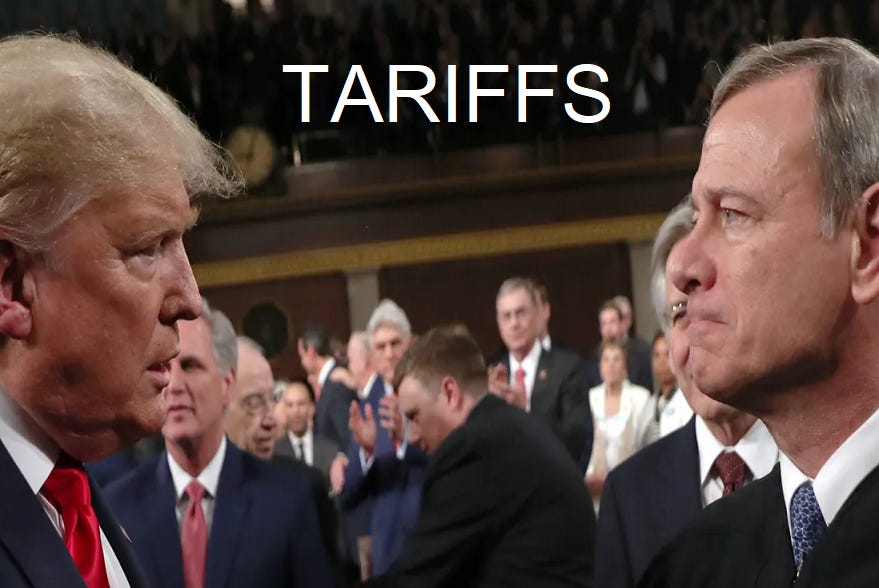
John Roberts: Our woke Chief Justice
Although IEEPA gave Trump the power to “regulate ... importation” of foreign property, it did not give him the power to issue tariffs— according to Justice John Roberts. Here is his reasoning: The text of IEEPA does not contain the word, “tariff,” and the chief justice asserts that legislation wording must be explicit and precise. It is a reasonable requirement, but not one that Roberts has always maintained.
In 2012, Roberts determine (initially) that the ACA legislation (Obamacare) was unconstitutional because it used a “penalty” to mandate that people buy health insurance. However, he voted for the ACA anyway after deciding that the “penalty” could be re-imagined as a “tax.” Thus, Roberts espoused a policy of enormous judicial restraint, whereby a court avoids striking down a law if a constitutional interpretation is “fairly possible.”
In view of his recent ruling on IEEPA tariffs, it appears that Roberts is no longer in the mood for judicial restraint.
More importantly, Roberts doesn’t seem to understand that he is supposed to be a legal scholar — not a grammarian. A disputed action should be evaluated by measuring it against the purpose of the law— not by playing word games that change the meaning of the law.
In the case of the ACA, Roberts knew that the purpose of the penalty was to coerce people to buy insurance — something he acknowledged was illegal and unconstitutional. However, to give President Obama a “win,” Roberts pretended the ACA penalty was a “tax.”
Similarly, Roberts knows that the primary purpose of Trump’s tariffs is to coerce behavior by our trading partners in order to reduce our trade deficit, make sure that essential products are produced in America, increase employment rates, reduce drug deaths, and promote peace in volatile parts of the world. However, Roberts is again ignoring the purpose of legislation— but this time it is to give Trump a “loss.”
Roberts is not the only justice to vote against the Trump tariff scheme. Amy Barrett and Neil Gorsuch were also troubled by the omission of the word “tariff” from the IEEPA text. However, they are consistent in their rulings.
The views of the other justices
Clarence Thomas, Samuel Alito, and Brett Kavanaugh supported the Trump tariffs, and their views were well-represented by Kavanaugh’s written dissent, where Kavanaugh said that Trump’s lawyers effectively “checked the wrong box.” Most of the Trump tariffs would have qualified under other sections of the Code.
His dissent outlined three core arguments:
The language of IEEPA is broad enough to include tariffs because it grants the president with the right to “regulate importation.”
Courts should give deference to the president in matters of foreign affairs.
Overturning the IEEPA tariffs could cause major disruption and economic loss to the country.
I won’t waste time on the three court liberals (Kagan, Sotomayor, and Jackson). Does anyone seriously think they would have voted against these tariffs if they had been proposed by President Obama or Biden?
The future of Trump’s tariffs
As widely reported, the Trump Administration is about to use the Trade Act of 1974 (Section 122) to impose a 15 percent tariff in cases where IEEPA tariffs have been declared illegal. That may give the Administration about 5 months to make more permanent arrangements, but Democrats are already getting ready to file their lawsuits.
A good alternative to IEEPA and Section 122 might be the Tariff Act of 1930 (Section 338). It could be applied to any country that is found to be discriminating against the U.S. in its trade activities. Under the 1930 Act, a tariff of up to 50 percent could be imposed, provided the Trump Administration can show a need based on “large and serious” balance-of-payments deficits.
The political impact of the tariff ruling
The European Union is reevaluating its trade deal with the U.S., and other countries are also likely to re-assess trade arrangements. Treasury Secretary Scott Bessent and President Trump claim that the trade agreements will not be significantly impacted.
In the short term, the Supreme Court ruling is sure to have a negative impact on President Trump’s momentum and credibility. However, if President Trump is able to customize and fine-tune tariffs under other tariff provisions, the impact on the midterm elections may be minimal.
Indeed, it is possible that the Trump Administration will make a little lemonade from its tariff lemons. Although the general inflation rate has subsided, it is still high for certain critical consumer items, such as food (3.1% in 2025). The prices paid for those highly visible items must be lowered if Republicans are to do well in the 2026 midterm elections.
Excellent article, multi-kudos!
Thanks for another informative article, Joe. It's too bad that the Trump team didn't anticipate this issue and "check the right box" from the start. But I have the benefit of hindsight I suppose.